
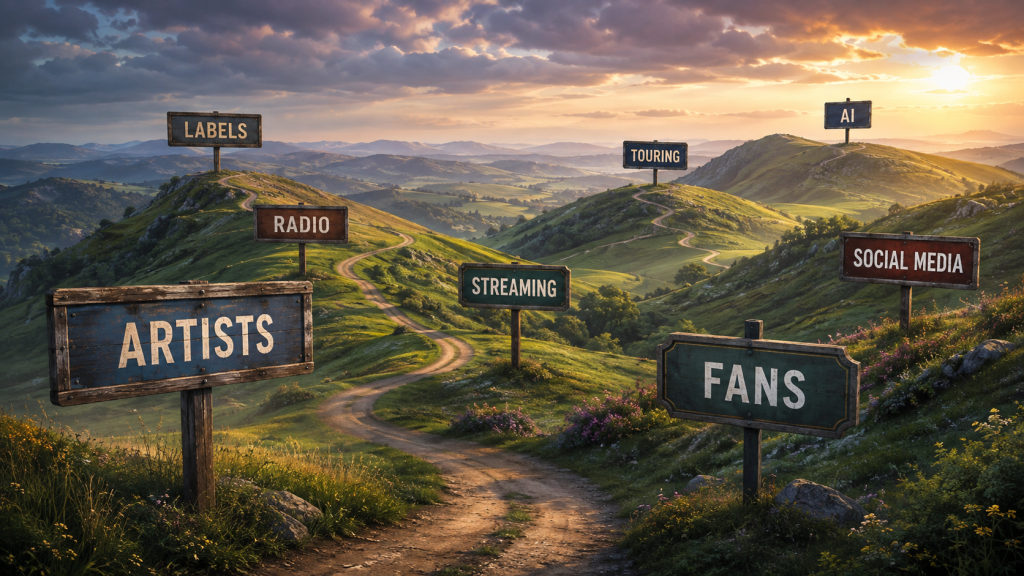
For most of the twentieth century, the music industry operated through a relatively understandable chain of command.
Artists made music. Record companies financed, recorded and distributed it. Radio stations introduced it to the public. Retail stores sold it. Music publications reviewed it. Fans purchased albums, attended concerts and helped turn promising performers into stars.
The system was never simple or fair, but everyone understood the basic structure.
That structure is disappearing.
Music is now easier to create, release and hear than at any other time in history. An artist can record a song at home, distribute it around the world and reach listeners without receiving permission from a traditional record company. Fans have access to almost every style and era of music through a device they carry in their pockets.
This should be the greatest period in music history.
In many ways, it is.
The tools available to artists would have seemed impossible only a generation ago. Recording no longer requires an expensive studio. Distribution no longer depends on manufacturing physical products. Musicians can communicate directly with audiences, build communities and maintain ownership of their work.
But greater access has created a different problem.
There is more music than anyone can possibly hear.
Thousands of new songs arrive every day, joining a catalog that already contains nearly every major recording from the past century. Listeners are not struggling to find music. They are struggling to decide what deserves their attention.
That has changed the role of nearly everyone in the industry.
Record companies once controlled access to recording studios, distribution networks and retail shelves. Today, their greatest advantages are money, marketing experience, audience data and the ability to command attention. They are no longer the only route into the marketplace, but they remain powerful because reaching listeners can be far more difficult than releasing a song.
Radio once served as the primary engine of discovery. A station could place a new artist in front of millions of people and turn a regional act into a national name. Traditional radio still matters, but it now competes with streaming services, social media, online video, satellite programming, podcasts and millions of individually created playlists.
The local disc jockey who knew the audience has often been replaced by a recommendation system that knows what the listener played yesterday.
Algorithms are excellent at identifying patterns. They can recognize that someone who enjoys one artist may respond to another artist with similar characteristics. They can keep music playing indefinitely.
What they cannot always do is explain why a song matters.
Discovery has become efficient, but it can also become predictable. When recommendation systems are designed to reduce the possibility that a listener will leave, they naturally favor familiarity. The result is an endless flow of music that fits our established preferences without necessarily challenging them.
A great music curator does something different. A curator takes a risk. A curator places an unexpected song in front of an audience and says, “You need to hear this.”
That human judgment remains essential.
Social media has also changed the definition of musical success. Artists are increasingly expected to become constant content creators. A musician may spend as much time filming, posting and responding as writing, rehearsing and performing. Personality, frequency and visual presentation can become as important as the music itself.
A short clip can introduce a song to millions of people, but it can also encourage writers to treat the opening seconds as the only part that matters. Songs are sometimes built to create moments rather than complete experiences.
There is nothing inherently wrong with a powerful moment. Popular music has always depended on memorable hooks. The danger comes when the promotional fragment becomes more important than the song surrounding it.
The economics have changed as dramatically as the methods of discovery.
Recorded music once generated income through individual purchases. A fan bought an album whether it was played once or one hundred times. Streaming transformed that purchase into a continuing rental. It gave listeners extraordinary convenience, but it divided the value of music into tiny payments spread across enormous numbers of plays.
For the biggest artists, those numbers can become substantial. For many working musicians, streaming alone cannot support a career.
Artists increasingly depend on touring, merchandise, private performances, licensing, memberships and direct support from fans. Each of these can provide meaningful income, but they also require musicians to operate as independent businesses. The modern artist is expected to be a songwriter, performer, producer, marketer, salesperson and community manager.
That expectation is exhausting for emerging artists. It can be even more difficult for established musicians whose careers began under an entirely different system.
An artist with twenty, thirty or forty years of experience may still be creating remarkable music. Yet the industry often treats that artist as a legacy attraction whose value exists only in familiar hits. New songs receive less attention because programmers, publishers and promotional systems assume audiences are interested only in the past.
Masters Radio was created to challenge that assumption.
We believe established artists still have something to say. Experience should deepen an artist’s voice, not disqualify it from being heard. The music industry celebrates longevity while frequently ignoring the new work produced by the people who achieved it.
Our Masters Period recognizes artists who have spent at least twenty years developing their craft. We are not interested in placing them behind glass. We want to hear what they are creating now.
That mission becomes even more important as artificial intelligence begins to influence the creative process.
Artificial intelligence can help generate lyrics, melodies, arrangements, instrumental performances and vocal ideas. The reaction has ranged from excitement to fear, much as it did when synthesizers, drum machines, sampling and digital recording entered the industry.
The real question is not whether musicians will use new tools. They always have.
The more important questions involve ownership, permission, credit and compensation. Who controls the work used to develop these systems? Does an artist have the right to prevent a voice or style from being imitated? If technology contributes to a recording, how should that contribution be disclosed? Most importantly, does the technology expand human creativity or simply produce cheaper versions of what already exists?
These questions cannot be answered by technology companies alone. Artists, songwriters, producers, rights holders and listeners all have a stake in the outcome.
New tools can give musicians more freedom to experiment. They can make professional capabilities available to people who could never afford traditional production. They can also flood the marketplace with imitations, make authorship more difficult to identify and place additional pressure on musicians who are already competing for attention.
The value of music cannot be measured only by how quickly or inexpensively it can be produced.
Music becomes meaningful when intention, experience and emotion give sound a reason to exist. Technology may help shape that sound, but people must decide what deserves to be said and why anyone should care.
The future of the industry will not be determined by a contest between people and machines. It will be shaped by the choices people make about how machines are used.
Artists will need better ways to control their work. Fans will need better ways to support the music they value. Platforms will need to decide whether they exist simply to capture attention or to create lasting connections between musicians and listeners.
The industry will continue to change because it has always changed. Sheet music gave way to records. Records gave way to radio, tapes, compact discs, downloads and streaming. Each transition created opportunities, destroyed familiar businesses and inspired predictions that music itself was in danger.
Music survived because the human need behind it never changed.
We still use songs to remember people, understand ourselves, celebrate, grieve, protest, escape and connect. No distribution model invented that need, and no algorithm can eliminate it.
The landscape is changing.
The path between an artist and an audience is being rebuilt.
Our responsibility is to make sure the music does not get lost along the way.