
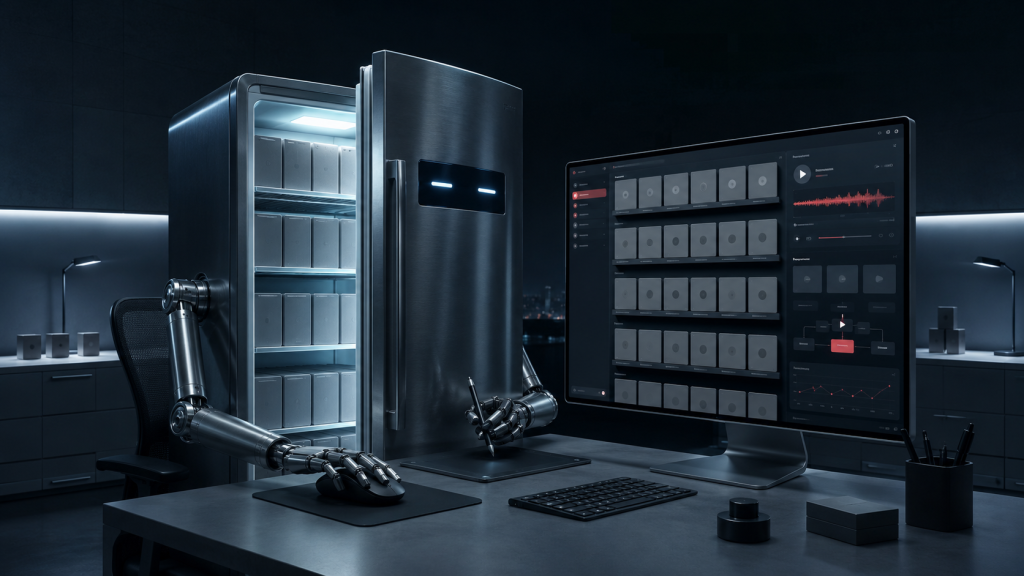
Open almost any major music application and the experience feels strangely familiar.
There is a dark background. There are rows of square album covers. There is a search bar, a library and a home screen filled with recommendations. Somewhere near the top is something recently played. Beneath it are playlists for working, relaxing, exercising, sleeping, driving, studying or attempting to survive Monday morning.
Everything is organized.
Everything is efficient.
Everything looks like it was designed by a refrigerator.
That is not entirely an insult. Refrigerators are useful. They preserve an enormous variety of products, arrange them on convenient shelves and keep everything available until someone wants it.
They are also cold, silent and completely without personality.
That is increasingly how music streaming feels.
The great promise of streaming was access. Nearly every album, artist and genre could live inside one service. Listeners would no longer be limited by what a local store stocked or what a radio station decided to play. Music history would become available instantly.
That promise was fulfilled.
The problem is that access and discovery are not the same thing.
Access means the song is available.
Discovery means someone gives you a reason to care about it.
Streaming platforms solved the first problem brilliantly. They built enormous digital warehouses capable of delivering almost any recording within seconds. But the larger those warehouses became, the more difficult it became to help listeners understand what was inside them.
The solution was the algorithm.
Recommendation systems examine listening behavior, saved songs, skipped tracks, playlists, time of day and the habits of other people with similar tastes. They use those signals to predict what someone is most likely to play next.
This can be remarkably convenient.
If you enjoy one artist, the system can quickly find others who share similar musical characteristics. If you listen to quiet acoustic music every evening, the application will learn to provide more of it. If you repeatedly skip a particular style, that style gradually disappears from view.
The system becomes very good at giving you more of what it believes you already want.
That is not necessarily discovery.
It is often confirmation.
True discovery usually involves an element of surprise. It happens when a trusted friend plays something unexpected, when a radio host explains why a song matters, or when a record store employee places an album in your hands and insists that you listen to track four.
Those experiences contain risk.
The person making the recommendation might be wrong. You may dislike the song. You may wonder what they were thinking.
But you may also hear something that changes your understanding of music.
Algorithms are designed to reduce that uncertainty. They learn from what worked before and search for another selection likely to produce a similar response. Their purpose is not necessarily to challenge the listener. It is to keep the listener from leaving.
That difference shapes the entire experience.
Music applications are designed to remove friction. Songs begin instantly. Playlists continue indefinitely. One selection flows into the next without requiring a decision. The listener does not need to know the artist, the album or the story behind the recording.
The music becomes a continuous utility.
It fills the room while we do something else.
That may be useful for background listening, but music was not created merely to prevent silence.
Songs carry stories, arguments, memories and emotional risks. Artists make choices about words, sounds, arrangements and performances. Albums often reflect a particular moment in a life or career. A new recording from an established musician may represent years of experience, loss, change and survival.
Most music applications compress all of that into a small square and a play button.
The artist becomes content.
The song becomes data.
The listener becomes a collection of behavioral signals.
Even personalization can feel strangely impersonal. A playlist may carry your name, reflect your habits and be described as uniquely yours. Yet it has been assembled through the same process used for millions of other people.
The application knows what you played.
It does not know why you played it.
It may recognize that you returned to a particular song repeatedly during one week. It cannot understand that the song reminded you of someone, helped you through a loss or arrived at precisely the moment you needed it.
Human beings hear meaning.
Machines detect patterns.
The visual sameness of music applications reflects this mechanical approach. When every service is competing to make listening faster and easier, they tend to arrive at similar solutions. Album tiles become inventory labels. Horizontal rows become shelves. Search becomes a way to locate a known item. Recommendations become the products placed at eye level.
The interface is not inviting you into a culture.
It is helping you select something from storage.
What is missing is a point of view.
Great radio stations had personalities. You knew the voices, trusted certain hosts and understood what a station stood for. Record stores developed reputations through the people who worked there and the music they placed in the window. Music magazines introduced scenes, started arguments and made readers curious about artists they had never heard.
These places did more than provide music.
They created context.
Context is what transforms a song from an audio file into part of a larger story. It tells us where an artist came from, what changed, why the new work matters and how it connects to everything that came before it.
Streaming platforms are not unaware of this problem. They employ editors, develop curated playlists and experiment with commentary. Spotify itself has reported that listeners are more willing to try unfamiliar songs when recommendations are accompanied by spoken context.
That should not be surprising.
People respond to people.
The future of music discovery should not require abandoning technology. Algorithms can help organize vast catalogs and identify connections no individual curator could find alone. They are valuable tools.
They should not become the entire personality of the experience.
The strongest music platform would combine technological reach with human judgment. It would use data to find possibilities and people to explain why those possibilities deserve attention. It would encourage exploration instead of endlessly reproducing past behavior.
Most importantly, it would remember that artists are not interchangeable pieces of content.
That belief sits at the center of Masters Radio.
We focus on new music from established artists because those songs are frequently buried by systems that prefer familiar hits or younger performers receiving current promotional support. An artist may have spent decades developing a voice, yet a new song can disappear because the algorithm has already decided what listeners expect from that name.
We want to interrupt that assumption.
Our role is not simply to place another song in a row of album covers. It is to introduce the artist, provide the story and give listeners a reason to pay attention. Features, interviews, commentary and human curation restore the personality that large platforms often remove.
Music discovery should feel like entering a room filled with people who cannot wait to tell you what they found.
It should feel unpredictable, personal and alive.
It should occasionally confuse you.
It should sometimes challenge you.
It should create the possibility that you will hear something you were not searching for and wonder how you ever lived without it.
A refrigerator cannot do that.
It can preserve the music, organize it and keep it ready.
But somebody still has to open the door, reach past the familiar choices and say, “Listen to this.”
Sources and Further Reading
Spotify, how signals shape personalized recommendations
Spotify, why commentary can encourage listeners to try unfamiliar music
United Kingdom Government, review of research into streaming algorithms and music consumption
Transactions of the International Society for Music Information Retrieval, Diversity by Design in Music Recommender Systems