
There was a time when one person in one radio station could change the future of a band.
A record arrived at the station. A music director or disc jockey listened to it. Something in the song created a reaction that research, charts, or audience data could not explain. The DJ played it. Maybe the audience hated it. Maybe nobody called. Maybe the program director demanded to know why several minutes of valuable airtime had been given to a band nobody recognized.
Or maybe the telephone lines lit up. Listeners asked who the artist was. They wanted to hear the song again. Record stores began receiving requests. Another station heard about the response and added the song. A nearby market followed. The record caught fire. This was not an efficient system. It was a human one.
Local radio once allowed musical risk to begin on a manageable scale. A DJ did not need to convince the entire country that a song would succeed. The DJ only needed to believe that it might matter to the people listening in that city.
If the record failed, it failed in one market during one portion of one program. If it worked, the response became evidence. The risk came before the data.
Today, everyone wants the data before taking the risk. That reversal has changed music.
One of the most famous examples began in Memphis in 1954. Elvis Presley was still an unknown nineteen year old when Dewey Phillips played “That’s All Right” on WHBQ. The record did not arrive with national streaming numbers, a viral video or a coordinated promotional campaign.
Phillips heard something. He played it. Listeners began calling the station. He played it again and then several more times. Elvis was reportedly so nervous about hearing himself on the radio that he had gone to a movie theater. He was eventually brought to the station for an interview.
A local decision created a local reaction. That reaction helped launch something much larger.
Twenty years later, another DJ made a similar decision in Cleveland. Donna Halper was the music director at WMMS when she received the first album from a largely unknown Canadian band named Rush. The band had pressed the record through its own label and had struggled to attract meaningful attention.
Halper listened to the album and selected “Working Man.” It was not an obvious radio single. It was more than seven minutes long. The band had no established audience in the United States. There was no national campaign telling Halper that the record was important. She believed the song would connect with Cleveland.
The city was filled with factories and people who understood exactly what it meant to get up, go to work, and feel that there was no time left for living. Halper recognized the relationship between the song and her audience.
She put it on the radio. Listeners called. They wanted to know whether it was a new Led Zeppelin song. They wanted to hear it again. Record stores began asking for copies. The response helped bring Rush to the attention of Mercury Records.
A band that could barely get noticed in Toronto found its way into the United States because one person in Cleveland understood one song in relation to one city.
No national algorithm could have made that decision. The important information was not contained in the recording alone. It existed in the relationship between the music, the market and the person listening. That was the power of the local DJ.
Radio personalities knew their communities. They understood which clubs were crowded, which records people requested and which artists inspired arguments. Their taste became part of the station’s identity. A great DJ did not simply play what the audience already liked. A great DJ taught the audience what it might like next.
That required courage because every unfamiliar record carried the possibility of failure. A strange voice could make listeners change the station. A long song could disrupt the schedule. An artist without name recognition could consume airtime that might have been given to a proven hit.
But failure was contained. One DJ could try one record in one market. If the song connected, the fire spread.
This created a national music culture from thousands of local decisions. Memphis could discover one sound. Cleveland could embrace another. College stations could support artists ignored by commercial radio. Regional scenes could develop before the rest of the country understood what was happening.
Success did not always descend from the top. Sometimes it climbed from the bottom. The system was never pure. Record companies pressured stations. Payola existed. Consultants influenced playlists. Popular artists received advantages, and many deserving musicians were still excluded. But there were more individual doors through which an unexpected song could enter.
Over time, ownership consolidation and centralized programming reduced the number of independent decisions being made. The Telecommunications Act of 1996 eliminated national radio ownership limits and relaxed local limits. A Government Accountability Office study later found that the ten largest owners increased their share of commercial stations from four percent in 1996 to twenty percent in 2009.
That did not eliminate every independent DJ or adventurous station. It made individual risk more difficult to justify. When programming decisions are centralized across multiple stations, an unsuccessful choice no longer affects one city. It can affect an entire network. The safer decision is to use songs with proven research, familiar names, and promotional support. The local experiment becomes a national calculation.
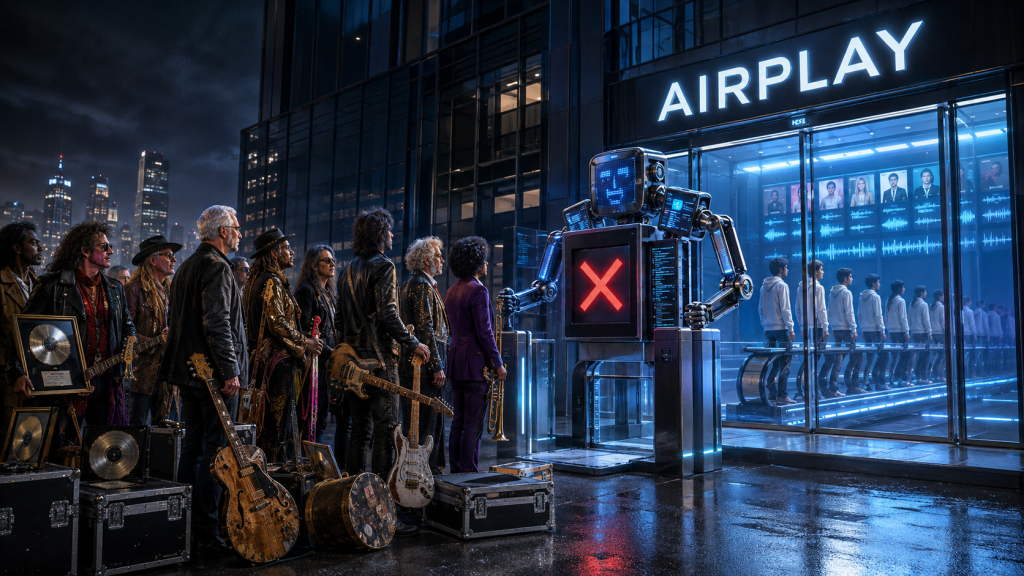
Streaming and social media were supposed to reverse this problem. Anyone could release a song. Every artist could reach the world. No radio programmer could prevent music from becoming available. That promise was fulfilled.
Availability, however, is not the same as attention. A song can now be available everywhere and heard nowhere. Modern gatekeepers examine streams, saves, completion rates, followers, shares, and social activity. Record companies can wait for artists to develop audiences before offering support. Radio programmers can wait for a song to prove itself elsewhere. Playlist editors can wait for momentum.
Everyone waits for someone else to take the first risk. An artist approaches the industry and hears the same questions.
- How many followers do you have?
- How many people are streaming the song?
- Has it gone viral?
- What is the engagement rate?
- Who else is involved?
The question nobody wants to ask is the one that once mattered most. Is the song good? This fear travels backward into the creative process.
Writers shorten introductions because listeners might skip. Choruses arrive sooner. Producers use sounds the audience already recognizes. Labels encourage artists to remain inside established genres. Marketing teams search for a social media moment before the song has developed an emotional life.
Everyone wants originality. Nobody wants to be responsible if it fails. That is how musical risk dies. It does not disappear through censorship. It disappears through a thousand reasonable decisions made by people protecting themselves from uncertainty.
The songwriter chooses the safer phrase. The producer removes the unusual section. The label selects the song most similar to the previous hit. The programmer waits for research. The platform recommends what has already produced engagement. The listener receives another version of something already familiar.
None of these decisions is irrational. Together, they create a culture terrified to surprise itself. Music needs failure.
Every important musical movement contains records that initially confused people. New sounds often appear wrong before they become influential. Artists develop by attempting things that do not work, learning from them and trying again.
If every song must demonstrate commercial certainty before receiving exposure, music can only repeat what has already succeeded. We do not need to abandon data. We need to restore places where data is allowed to begin.
Give local DJs room to play something they believe in. Give independent stations space to develop personalities. Create regional discovery programs. Let music writers, record stores, artists and listeners recommend songs for reasons that cannot be reduced to prior performance.
Allow a record to fail in one place without disappearing everywhere.
At Masters Radio, that is part of our purpose.
We listen to new music from established artists because many of those songs arrive without the promotional machinery attached to their familiar hits. We are willing to make a judgment before millions of other people have confirmed it.
We may be wrong. That is the price of having a point of view. The DJ who played Elvis did not have national evidence. Donna Halper did not have an algorithm proving that Rush would connect with American listeners. They had ears, experience, and enough courage to put the record on.
The next musical revolution may already exist. It may be sitting on a hard drive, inside a small club or in the inbox of someone afraid to play it. Music does not catch fire because a spreadsheet approves it. It catches fire because somebody strikes the first match.
Sources and Further Reading
Rush, the official history of Donna Halper and “Working Man”
Northeastern University, how Donna Halper helped introduce Rush to the United States
American Songwriter, Dewey Phillips and the first radio broadcast of “That’s All Right”
United States Government Accountability Office, radio ownership and programming decisions following 1996
United Kingdom Government, the influence of recommendation algorithms on music discovery