
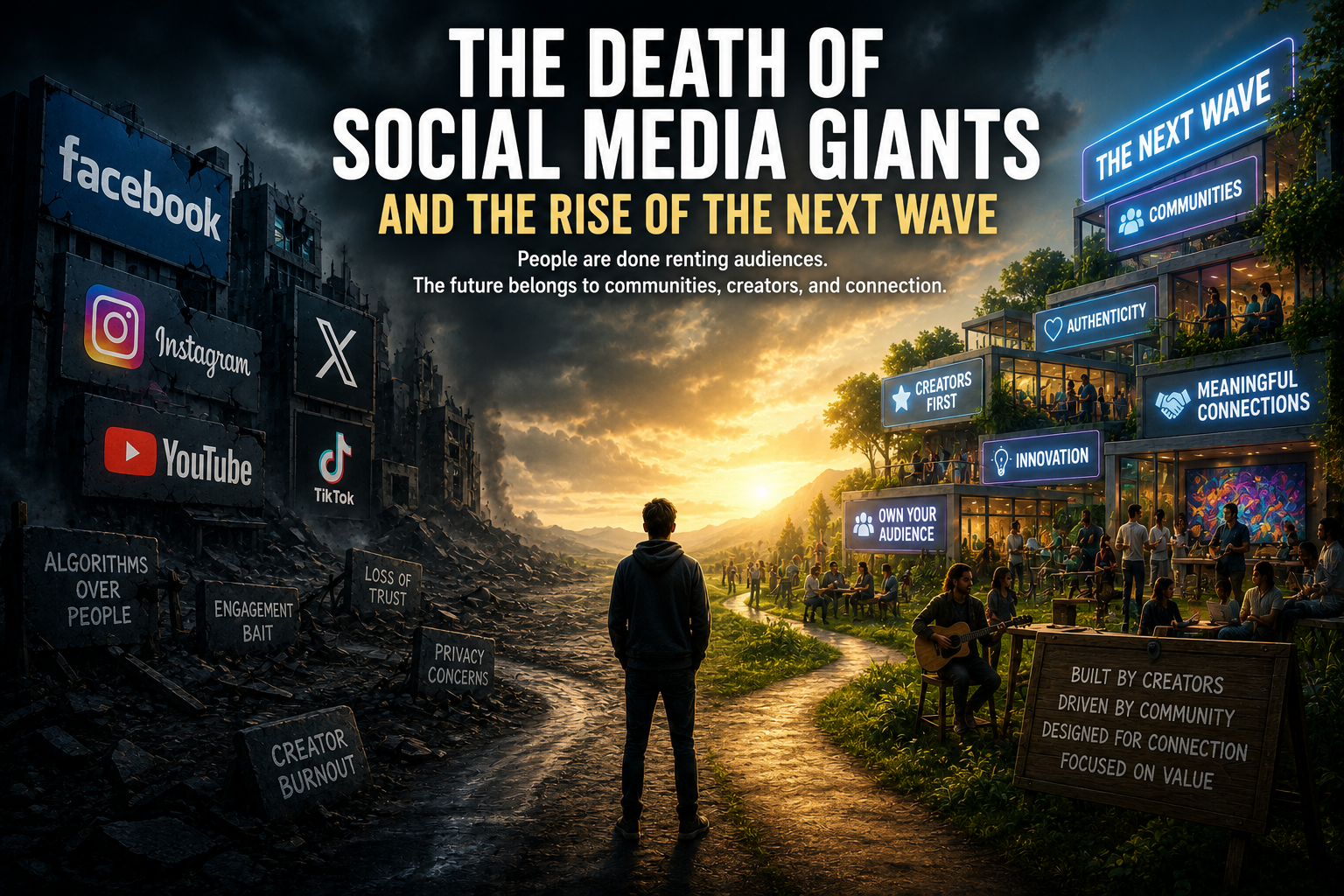
For nearly two decades, the internet has belonged to a handful of companies: Facebook, Instagram, X, LinkedIn, YouTube, and TikTok. Each arrived with a promise to connect people, democratize publishing, and give everyone a voice. For a while, they delivered exactly that. They helped launch businesses, reunite families, create careers, and even influence governments. Entire industries were born because these platforms lowered the barrier to reaching an audience.
Somewhere along the way, however, the priorities changed. Algorithms began to determine which relationships mattered, engagement became more important than conversation, and advertising increasingly shaped the community experience. Creators slowly realized they were renting access to the audiences they had worked to build.
Every musician, writer, photographer, podcaster, and entrepreneur knows how uncertain that arrangement can be. One day your content reaches thousands of people; the next day it reaches fifty. Your work hasn’t changed, but an algorithm inside a company you can’t influence has decided to distribute it differently. For years, creators accepted this because there wasn’t much of an alternative. Now, there are more ways to build a business around a direct relationship with an audience.
The weakness of large social platforms may be less apparent in their user numbers than in the trust people place in them. Users question what appears in their feeds, creators question whether their followers will see their work, and businesses question how much they must spend to reach customers they already know. The experience can feel like a machine constantly demanding more content while offering less certainty in return.
The demands are familiar: post more, create more videos, reply faster, follow the latest trend, and use the newest feature. Then hope the algorithm notices. It’s exhausting, and it leaves creators spending valuable time studying distribution systems instead of doing the work that attracted their audiences in the first place.
That pressure can shape the work itself. Musicians feel encouraged to write songs that will become fifteen-second trends. Writers chase headlines, photographers edit for feeds, and businesses publish because they fear disappearing if they stop. The internet becomes crowded with people producing content they don’t enjoy making because they’ve been told that constant activity is the price of staying relevant.
History offers some perspective on what might happen next. Television networks once controlled much of the entertainment business, until cable expanded the choices available to viewers. Streaming later challenged cable’s dominance. Yahoo helped define the early internet, Google changed how people searched it, and Facebook overtook a social landscape in which MySpace had once seemed difficult to challenge. Dominance can last a long time, but it rarely goes unchallenged.
Large companies don’t have to disappear for new opportunities to emerge. As they grow, they often become more predictable, more bureaucratic, and more focused on protecting existing businesses. Decisions that make sense for an enormous platform can leave smaller groups poorly served. Entrepreneurs gain an opening when they recognize those unmet needs and build something around them.
The next generation of platforms will need more than better technology. They’ll need to understand what people are missing from their online experience. Many people want communities where they can find expertise, build relationships, and explore shared interests without sorting through an endless stream of unrelated material.
Newsletters, private memberships, independent creator businesses, and specialized communities offer different ways to meet that need. Their appeal comes from a clear reason to participate. People arrive because they care about the subject, value the creator, or want to learn from others with the same interests. That shared purpose gives a smaller community something a giant public feed can struggle to provide.
In some ways, this recalls the early internet, when people gathered around music, photography, gaming, technology, cars, travel, and books. Those communities were smaller, but participation often went deeper. Members recognized one another, returned to ongoing conversations, and contributed knowledge that made the community more useful over time.
Today, someone can have thousands of followers and still struggle to find meaningful interaction. A platform that helps people develop stronger connections has an opportunity to earn their loyalty. Its value will depend on what members get from participating and how much they would miss it if it disappeared. Fifty thousand people united by a genuine passion can sustain something valuable, even without the scale of a mass social network.
Music illustrates the opportunity particularly well. In a general feed, a song competes with recipes, an artist interview competes with cat videos, and an album release competes with political arguments. A listener may discover something wonderful, but the experience is designed to move them toward the next item almost immediately.
A destination built specifically for music discovery can offer a different experience. Readers can visit because they want to hear new music, learn about artists, and spend time with interviews. Musicians can reach people who are already interested in listening. The platform can organize its choices around helping that relationship develop, giving both the artist and the audience a reason to return.
Specialization allows a business to serve a particular audience with care and depth. A music platform doesn’t need to accommodate every possible interest or copy every feature of a large social network. It needs to understand its listeners, offer worthwhile discoveries, and make the experience valuable enough to become a habit.
That changes how success can be measured. Time spent scrolling tells a company something about activity, but returning to hear another song, reading an entire interview, or becoming a paying member can reveal more about the strength of a relationship. Expertise and thoughtful programming give people reasons to stay that extend beyond the appeal of the latest viral post.
For entrepreneurs, this creates an achievable challenge: build the best destination for a specific community. Doing that still requires hard work, good judgment, and a sustainable business model, but it doesn’t require attracting everyone on the internet. It requires serving a defined group well enough that they choose to come back and tell others about it.
Facebook and YouTube are unlikely to disappear anytime soon. They remain useful for discovery, distribution, and reaching people at scale. Their continued presence, however, leaves room for destinations that offer a deeper experience once someone discovers an interest worth pursuing. A specialized platform can grow alongside the giants while building relationships of its own.
Every generation has companies that seem permanent, even as smaller businesses begin to address needs those companies have overlooked. The next wave of internet businesses may already be taking shape in that space. Their founders are listening to particular communities, solving practical problems, and giving people a better reason to spend time together.
A better idea earns its place through the people it serves. When a community finds something worth returning to, sharing, and supporting, that idea has the beginnings of a future.