
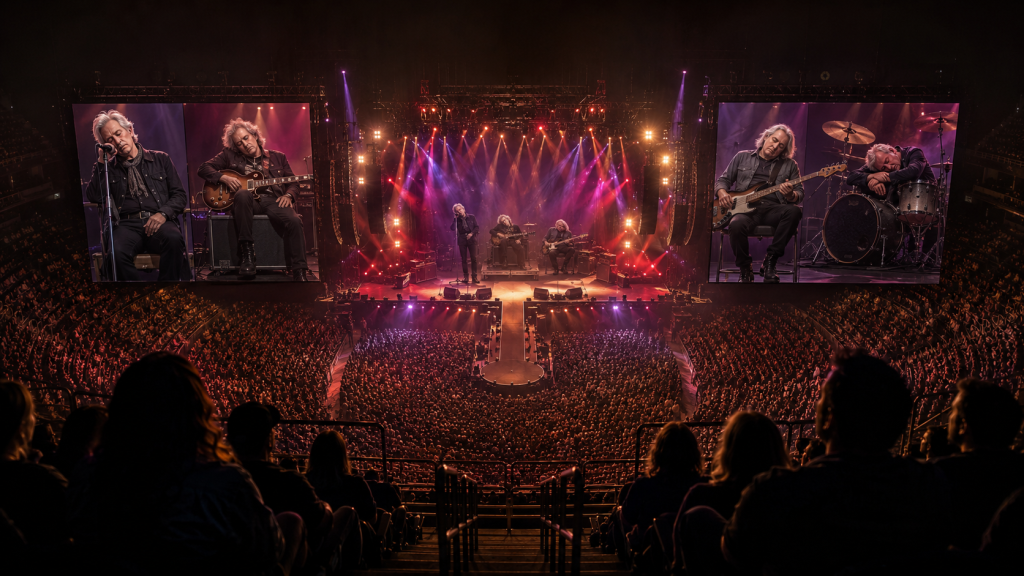
The lights go down.
The crowd rises. The opening notes hit, and for the next two hours the people onstage appear to exist outside normal human limitations.
They run. They shout. They sing songs recorded decades earlier. They recreate memories for thousands of strangers while making the entire performance feel spontaneous.
Then the lights come up, and everyone goes back to being tired.
The mythology of touring was built around hotel rooms, backstage parties, overflowing drinks and musicians behaving as if the next morning would never arrive. Some of those stories were true. Many were exaggerated. Almost all of them came from a time when the artists involved were much younger.
Your favorite band may still perform with the energy of its early years.
That does not mean its members are living like they did in their twenties.
For many established artists, the wildest thing happening after the show is someone looking for a cup of tea, a humidifier or enough ice to get both knees through the next performance.
This is not a decline in the rock and roll spirit.
It is how careers survive.
A concert may last two hours, but touring consumes the entire day. There is travel, loading, waiting, soundcheck, production meetings, interviews, meals at inconvenient times, promotional obligations and the strange emotional process of preparing to become the person the audience expects to see.
Then comes the performance.
Afterward, the body is exhausted, but the nervous system is still racing. Sleep does not necessarily arrive just because the show is over. The artist may be on a bus within an hour, traveling through the night before waking in another city to repeat the process.
The audience sees the destination.
The artist lives the distance between them.
That distance becomes harder with age.
A singer’s voice is a physical instrument. It can become strained, swollen or damaged. Guitarists and keyboard players manage problems with their hands, shoulders, necks and backs. Drummers perform an athletic routine while attempting to remain perfectly precise. Everyone must deal with disrupted sleep, unfamiliar food, changing climates and long periods away from home.
Recovery that once required a few hours may eventually require a full day.
The party after the show begins to look less attractive when another performance is waiting tomorrow.
For many veteran artists, touring becomes an exercise in discipline. Alcohol is limited or eliminated. Social events are shortened. Sleep is protected whenever possible. Exercise, stretching, vocal rest, medication and careful meals become part of the production schedule.
The legendary backstage rider may still exist, but the most important items are often practical. Water. Healthy food. Tea. Towels. A quiet room. Something that helps a tired body recover.
This is the less glamorous truth about musical longevity.
The artists who continue performing into their sixties, seventies and eighties are not ignoring their age. They are managing it.
They know how to conserve energy. They understand which habits threaten the next performance. They have learned that the audience does not care how exciting the previous night was if tonight’s show suffers because of it.
Many are also no longer interested in pretending every city is an opportunity for chaos.
They have spouses, children, grandchildren, homes and responsibilities. They may finish a concert and call their families. They may return to the hotel and watch television. They may sit quietly because silence is the only way to protect the voice everyone has paid to hear.
That reality does not fit the popular fantasy of touring.
It is also far more human.
The road has always demanded more than audiences could see. What has changed is that artists are now expected to remain visible even when they leave the stage.
The modern musician does not simply perform.
The modern musician must produce content.
Every tour stop is expected to generate photographs, videos, backstage clips, interviews and social posts. The artist is encouraged to document the journey, respond to fans, promote the next appearance and create a steady stream of material for platforms that punish silence.
An artist may have spent forty years developing a musical identity and still be told that the day requires three short videos and a clever caption.
Social media has given musicians an extraordinary way to reach listeners directly. It can help an artist maintain a community without depending entirely on record companies, radio stations or traditional publications.
It can also turn a career into a content factory.
The pressure is relentless because there is no obvious finish line. A successful post must be followed by another successful post. A quiet week can feel like disappearing. The artist begins measuring each idea by whether it can be filmed, shared and converted into attention.
Even rest becomes content.
The day away from the stage is no longer simply a day away. Someone wants a photograph from the bus. Someone wants a message for the fans. Someone wants a clip explaining what happened last night.
The audience sees connection.
The artist may experience another obligation.
Research into musicians’ social media use has described this feeling as working in a content factory, with artists reporting pressure to remain constantly visible while trying to protect their mental health and creative identity. Research published through the National Library of Medicine examines this growing burden.
Touring itself creates a separate set of risks. Musicians and crew members experience disrupted sleep, isolation, financial uncertainty, performance anxiety and long separations from their support systems. MusiCares and the JED Foundation point to research showing elevated risks of depression and suicidal thinking among touring professionals. Their touring mental health guidance is a reminder that the people creating a night of entertainment may be carrying difficulties the audience cannot see.
Exhaustion does not always look dramatic.
Sometimes it looks like someone becoming quiet.
Sometimes it looks like an artist losing interest in talking after a show.
Sometimes it looks like a canceled appearance, an uneven performance or a social media account that has not been updated recently.
Fans can interpret those things as arrogance, laziness or a lack of gratitude.
They may actually be signs that a human being has reached a limit.
The financial reality makes stepping away difficult. Recorded music does not provide reliable income for many working artists. Touring, merchandise, private appearances and direct fan support can be essential to keeping a career operating.
A musician may continue touring because performing remains deeply meaningful.
The musician may also continue because people depend on the tour.
A major production supports musicians, crew members, drivers, technicians, managers and local workers. Canceling a show affects far more than the person whose name appears on the ticket.
That responsibility can make it difficult for an artist to admit that something hurts.
There is a strange contradiction in the way we treat veteran musicians. We celebrate their longevity but expect them to perform as if no time has passed. We want the original songs, the original key, the original energy and the original personality.
We want the memory without acknowledging what it costs to recreate it.
Aging does not make an artist less meaningful. Experience can deepen a performance. A familiar lyric may carry more weight when sung by the person who has lived with it for forty years.
But experience does not make the body indestructible.
At Masters Radio, we focus on new music from established artists because we believe their creative lives deserve to continue. That also means recognizing the people behind the music.
They are not nostalgia machines.
They are working artists balancing creativity, commerce, health, family and the expectations of audiences that may have known them for most of their lives.
Supporting them requires more than cheering when the familiar song begins.
Listen to the new work. Purchase music and merchandise directly when possible. Respect canceled dates when health intervenes. Allow artists to take breaks without declaring that they have disappeared. Remember that declining an afterparty, an interview or another photograph may be the decision that makes tomorrow’s performance possible.
Your favorite band may still look larger than life when the lights go down.
When the show ends, its members are probably looking for water, silence and somewhere comfortable to sit.
The party is no longer the point.
Getting back onstage tomorrow is.
Sources and Further Reading
Musicians’ Union, protecting health and wellbeing while touring
MusiCares and the JED Foundation, mental health challenges experienced by touring professionals
Berklee College of Music, how social media burnout affects musicians
National Library of Medicine, research into musicians working in the content factory
The Guardian, veteran musicians discuss continuing to tour later in life